Friday, September 25, 2009

Advanced Material Chemistry + Poem = !Warning! May cause brain hemorrhage!

For my Advanced Materials Chemistry course we were assigned to write a poem from a choice of three researches. I wrote mine on Geoff Ozin, Canada Research Chair and University Professor at the University of Toronto.

I tried to maintain an approximation of iambic pentameter, and I think I did a decent job considering how hideously clunky the technical terms are. Seriously, try getting the idea 'nanocomposites created by the combination of organic and inorganic subunits into a hierarchical structure' to fit in the frame of poetry. I dare you. Anyways, here it is.

Paean to a Canada Research Chair


“There's room at the top!” Geoff Ozin exclaims

Not just at the bottom as Feynman once claimed

By building at all scales using tiny blocks

He's given the world a new tool for its box:

This self-assembly has Geoff won great acclaim.


As a fascinating letter to Nature related,

Photonic bandgaps of silicon were created.

By storing information with light.

We'll bid electronics goodnight

In the computing revolution he instigated.


One grand challenge is not enough for this man

Chemical nanomachines are part of his plans

To seek and destroy nasty pollution

Nanobots will whiz around in solution

Or sail on the surface like a catamaran.


His articles make him among the top in citation

Which he can attribute to much innovation.

By ordering units into a hierarchical whole

Over structural properties he's gained much control

With an astounding range of potential applications.

Sunday, June 14, 2009

Schrödinger's Blog

I've always believed I publish online so that my writing would be enjoyed by my friends as well as subject to criticism. By writing, I am forced to choose a position and be able to defend it. Unless I write, I will strongly hold beliefs without good reasons, and I find I'm forced to agree with every contrary opinion I come across, which is quite painful.

I've always thought that, so long as I write, I should post it online for others to see. As a result, my blog is like Schrödinger's Cat, except closer to dead than alive. You can visit my page and determine whether my blog is still alive, but one update is no guarantee that others will follow. But after months of not updating, I'll post something and show that it's not really dead.

I don't like the zombie-status of my blog. I've realized that I don't really care that people be able to criticize what I write, because there have only been a few constructive comments from strangers. I'd like my friends to read my blog, but I suspect you're all bored of it. So, my friends, if you're actually still interested in my opinions, let me know and I'll post them online. Until then, I'll be writing for myself.

Tuesday, May 26, 2009

What? A Blog Post?! About B.C. Elections? Never Mind...

Well, this is my first post of 2009. I expect that you are less interested than the death penalty or the future of my blog than B.C. politics. I'm writing those later so that they appear first.

The provincial elections were on May 12, 2009. I left on April 30, and voting in advance was less of a priority than moving to Mississauga. I'd hoped to vote in support of the electoral system I previously discussed, Single Transferable Vote. I don't want to rehash the details of the system, but I find the politics interesting, and maybe more broadly applicable.

Essentially, STV promises a more proportional and local system to elect politicians. Electoral reform was a campaign promise of the governing party, the Liberals, and the particular system was chosen by a Citizen's Assembly which I believe was chosen to be geographically representative. The vote has failed in two referenda, and I doubt it will be proposed again in 2013.

What puzzles me is why the Liberals promised to reform the electoral system to being with. They haven't always been in power, but they are the dominant party in BC, so they have the most to gain from an unrepresentative system. I have a couple of ideas. One is that districts would have been combined, leading to less representation of rural areas, which tend to favour the opposing party, the NDP. The other is that the Liberals would still dominate under STV, but election results would fluctuate less. If the Liberals feel they can build coalitions more easily than the NDP, they might not lose much power under STV. Finally, they might have just wanted to take this idea away from the NDP, and make it their issue.

Hey! If you skipped over the previous paragraphs that were all blah blah BC blah blah elections, you might as well read this paragraph. What struck me, and led me to write this post, is that I had never considered the Liberals' ulterior motives for reforming the system. But politics is all about spinning ulterior motives into common principles. That doesn't make STV a worse system than FPTP, but it's important not to be deluded.

I hope you enjoy that I am writing again. Now that I work and have free evenings, I have time to think and write, so I expect new posts will appear.

Sunday, December 14, 2008

Insomnia, My Old Friend

Although I've always had occasional insomnia, it's been more of a problem recently. Usually, the source of my insomnia is straight-forward: too much caffeine too late in the day, or a late nap that disrupts my sleep schedule. What's unusual about my recent bout of insomnia is that it has directly resulted from my attempt to establish a sleep schedule. By trying to sleep properly, I've actually managed to mess up the dysfunctional schedule I had before.

I haven't had a regular sleep schedule for years. Starting in about 10th grade, I've had more of a cycle than a schedule. I'm naturally inclined to stay up late, but when I had school I had to get up at 7 am on weekdays. Instead of falling asleep at 10 pm and getting sufficient sleep, I would steadily deprive myself of sleep until I was too tired to stay up late, when I would go to bed between 9 and 10 pm, restarting the cycle. I couldn't catch up on my sleep on weekends because I would usually stay up even later and be woken up around 9 am. In summer, I had no weekday restriction on the time I woke up, so I would go to bed any time from 10 pm to 4 am and wake up between 9 am and 3 pm, with no real routine.

Although I wouldn't say that my sleep cycle has been beneficial, it's how I've lived for the past five years, so I must have managed somehow. In high school, I only rarely dozed off in classes, although probably more often than people who managed their sleep habits better. At university, I'm more likely to skip classes than sleep through them, although last year I fell asleep often in phys chem, as it was between organic chem and poli sci. Thankfully, not sleeping regularly hasn't severely affected my life thus far, as I've been happy and done well in school.

At times, I would attempt to fix my sleep schedule by going to bed early each night, but I was never committed enough to actually fall into a routine. Going to bed early might have worked in high school, when I was waking up at 7 am five days a week, but we'll never know whether it would have worked had I seriously tried it. My attempts at university all ended quickly, because I didn't have much of a routine to build off of. One night I would go to bed early and wake up early, while the next night I would go to bed early and wake up late, and on the weekends I would stay up and get up quite late, so there was little chance at my routinely going to bed and waking up early.

My latest attempt at establishing a good routine failed disastrously, but provided some insight into why all of my attempts have failed. At the beginning of the exam period, I decided that I would start going to bed at 10 pm each night and waking up when I felt rested. I reasoned that if I get enough sleep and go to bed at the same time, I'll eventually fall into a natural schedule. Unfortunately, it turns out that if I'm getting too much sleep, I won't be unable to fall asleep at night. Even if I go to bed at 10 pm every day, I won't wake up at 8 am if I fall asleep at 2 am, I'll wake up at 12 pm. Having to wake up for 8:30 am exams has even destroyed the cycle of deprivation and recovery I had before, with a chaotic system of recovering between exams and depriving myself of sleep before them.

That being said, I'm not particularly bothered by insomnia. So long as I've been getting sufficient sleep beforehand, I can lose sleep the night before an exam and still be alert. I've had insomnia often enough to know roughly when I should try and sleep and when I should do other activities until I'm more tired, so it's not like I'm wasting hours upon hours tossing and turning in bed. And most importantly, I know that my recent insomnia is temporary, and that once I've flown home for Christmas I can try sleeping regularly again. Next time around I'll know that waking up early is just as important as going to bed early, and if I don't succeed, at least I won't have to write exams and attend class.

Thursday, December 11, 2008

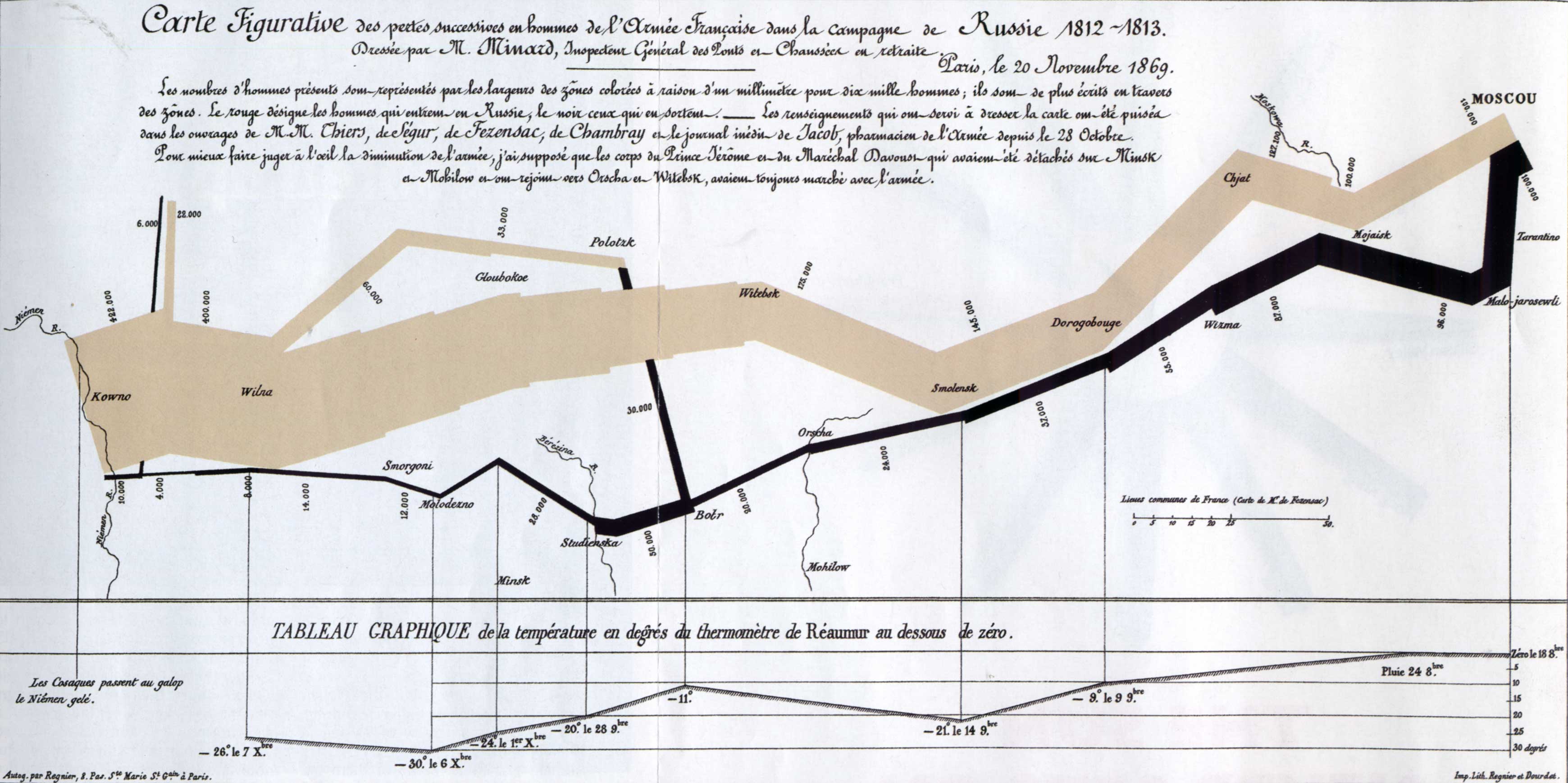
Charts I Heart, Part II

Since I wrote about a graph of baby names yesterday, I decided I had to write about this graph, because it is amazing and awesome. In case you don't read French micro-script, it's a graph showing Napoleon's army size during his Russian Campaign, as he advances on Moscow and then retreats. The numbers on this image are tiny, but a larger version shows that Napoleon left with 422,000 troops and returned with 10,000. The bottom of the graph shows the temperature at various part of the return. If a picture's usually worth a 1000 words, this graph is more like 10,000 words, or at least a textbook chapter. For instance, you can quickly see that Napoleon had lost 275,000 troops before even reaching Moscow, and that he lost a further 140,000 on the return home. There's simply a staggering amount of information contained in this graph, which is why I find it fascinating and had to share it.

Blog to the Future!

Now with -100% more Michael Fox.

Some of you may be wondering what the fate of this blog will be. Others may simply have concluded that it's dead, considering that I post less than once a month, on average. It certainly has declined precipitously in the past, from the golden age of posts about Middle Eastern politics and Vegetarianism, to the decadent decline of writing about math and dogs, and finally the stagnation of examining baby names.

I've occasionally been giving some thought to what I want to do with the damn thing. I'm loathe to officially declare it dead and never write again. I like pretending to have serious analytical skills and to pontificate about all kinds of complex phenomena, but I also like to babble on about charts and the optimal size of dogs. The problem is mostly that I don't know which I prefer, and writing about both leads to failure at both. The Expert Weblogger-Analyst tends to be embarassed by the irreverent posts, while the Silly Blogger dislikes all the half-researched, half-assed, too-serious posts.

One thing I can say for certain is that I will not try to write about myself. As an analytical person, I also analyze my own thoughts and behaviour. So long as I don't think too hard about the fact that I am meta-analyzing, it works ok. I come up with some vague ideas about myself, and it's all good. When I try to condense my notions into words I can shove down some intertubes, I get a headache. In other words: when my brain tries to come to a conclusion on my brain based on some brain observations my brain made, it breaks, and my head starts to hurt. I've foolishly attempted this a few times, and each time I walk away from my computer in (mild) pain and frustration. So, I can rule that topic out.

What will I be writing about? I've half a notion to separate this one web-log into the "Oliver values his opinions too highly" blog and the "Oliver's opinions are silly" blog. This could be the first step down a slippery slope, however, into a neverending mitosis of blogs that will eventually consume the internet. (Mitosis is cellular division where one cell splits into two copies.) A few days later I'll further subdivide my blog into "Oliver's Seriously Overinflated Opinions", "Oliver Hazards a Guess at Complex Topics Beyond his Comprehension", "Oliver Gets Drunk and Writes Blog Posts" and "Oliver Writes About Celebrities." Before you know it, I've created 10 million blogs and Google revokes my blogging license.

In all seriousness, I do have a plan for the future of this blog. For the next while, I'll be going through the archives and rewriting or removing my older, poor-quality posts. When I'm happy with everything I've written, and I will leave silly posts that have some point, I'll decide what I'm going to do in future. For now, hopefully you'll appreciate the fact that I'm writing again.

Tuesday, December 09, 2008

Names

I found an interactive chart that lets you see how a given name has changed in popularity over time. Apparently Oliver shot up in popularity around the year that I was born, so I guess my mom started a trend. Or at least followed a nascent one. Interestingly, although I've only ever met one Oscar in my entire life, compared to five Olivers within recent memory, Oscar's a more popular name. That may explain why people often think my name is Oscar, but I still think that's weird.

The other interesting trend is that the popularity of most of the traditional names like "John", "Charles", "Mary", or "Helen" has tanked over the past century. Although declining relatively constantly, they drop considerably at the same time that "Oliver" and other crazy names like "Isabel" and "Faith" become popular. Well, more popular. What was going on circa 1990 that made traditional names so boring?

I also like the names that spike in popularity and then die down. "Lisa" spiked at the beginning or WWII, peaked in the 60s, and hit bottom when the Simpsons came out. This crazy behaviour probably has to do with the fact that Elizabeth is a solidly popular name, whereas Lisa is a derived name that can become trendy and unfashionable quickly.

To wrap things up, I find charts way too interesting. It's just unreasonable.

Friday, October 03, 2008

An Even Worse Better Deal!

Woohoo, the bill passed!

Yesterday, I gave you two posts for the price of one, if you ignore the fact that posts don't have a well-defined price. Well, today I'm lowering the bar upping the ante: three posts for the price of two!

The U.S. and Canadian Election Debates
This post is really about the Canadian election, so it doesn't count as a U.S. election post, and I haven't broken my promise to only write about the U.S. election once, unlike our Prime Minister who broke his fixed election date promise (to reference Dr. Horrible, "[Stephen Harper] corporate tool.")

The first debate I watched was the Obama-McCain debate, which was pretty funny, but only because we had to take a sip of beer every time someone said something stupid, and I drank four beers over the course of the debate. The second debate I watched was Biden-Palin, which was interesting at first, but soured pretty quickly. The last debate, which I finished watching at 1:30 AM, was the Canadian English Language Debate. For those who are not Canadian, you may know that we have two official languages, and therefore two debates. We also run our elections in 6 weeks, unlike the two-year-long put-me-in-a-come-till-it's-over-I-can't-TAKE-IT-ANYMORE marathon of hot air, posturing, and electioneering that the U.S. has.

There is really a stark contrast between the U.S. debates and the Canadian ones. For one thing, you only have two parties, so it's more adversarial and rhetorical in nature. We have five parties, so although it's confrontational, the targets keep shifting, and policies play a larger role. Watching the ObCain debates, I was laughing at the ridiculous things each side was saying, with McCain saying most of them ("I'm a maverick! A maverick, y'hear! And don't forget it!"), but watching the BidPal debates left my pessimistic and jaded. Obama and McCain liked to throw out soundbites and attack each other, but they at least paid lip service to ides about competing policies, but Biden and Palin left policy at the door. They were both constantly posturing, pretending to respect their opponents while misrepresenting and attacking them, and it was sad to behold.

I'll admit that I'm a little biased in that I'm proud of our Canadian government when compared with the U.S. one. Compared to Bush, Harper looks like another Lincoln or FDR. But I honestly believe that democracy is considerably stronger in Canada than in the States. There was rhetoric and there were lies, but the focus was on policy and competence, not on photogenics. I was actually interested while watching it because I got to see each party present and defend their policy, and although a lot of it is campaign promises, the policies were generally good.

I'm going to discuss the policies that were mentioned, so if you're not interested in Canadian politics, you probably don't want to read further. (Which leaves me with Sherwood and Isabel, maybe.) I'm going to tackle the issues party by party, starting with the one I thought did the best and ending with my least favourite.

1st - The Green Party of Canada, led by Elizabeth May: obviously, they're Canada's environmentalist party, and although they argue that they're not on the left/right spectrum but are rather advocates for the environment, they're pretty solidly progressive. I agree wholeheartedly with a great many of their policies, but am rather put off by their economic policy. Although there's an environmental argument to focus on producing locally, they take things to far and seem to be advocating protectionism. Now, I'm not a zealous free-tradist, as I think protectionism in the developing world is often justified, especially in capital markets, but protectionism in the developed world for populist reasons is simply inexcusable. All in all, I don't think the Green's economic policies are all that great, but they're the most likely to confront global issues like poverty and the environment, so they'd get my vote in theory. It's not very likely, but I really hope the Greens win a seat and start to play a larger role in government.

2nd - The New Democratic Party, led by Jack Layton: he was pretty amusing in the debate, as he had the best jabs and argued more passionately than others. The NDP is Canada's leftist party, (although if you consider environmentalism leftist, then it's more complicated), and they're the party that brough nationalized healthcare to Canada, which we generally consider a Good Move. And indeed, their social and economic policies have the greatest appeal to me, although I don't universally approve of them. For one thing, although both the Liberals and Greens have a green tax-shifting policy, the NDP does not, and generally isn't as concerned about the environment as social problems. However, I quite like their social justice problems, and was impressed that Layton brought up the social problems of the Natives. It's a close call between the Greens and NDP, but I'm not voting for either so the call is pretty arbitrary (shock horror! Not voting for my favourite party? Don't worry, all will be explained below.)

3rd - The Liberal Party, led by Stephane Dion: If you'd asked me a few months ago what I thought of the Liberal party, I'd probably have ranked them barely above the Conservatives (spoiler: they're at the bottom by a lot), and yet they're pretty close to the Greens and NDP. The Liberals are Canada's left-of-centre party, so as a fairly progressive person, there's a lot about the Liberals that I find objectionable. I wasn't really paying attention at the time, but I found the Liberal government under Paul Martin pretty lacklustre and incompetent. Under the Conservative government, I was really frustrated by their willingness to tacitly cooperate with the Conservatives, as Stephane Dion instructed his MPs not to vote on key issues. So far as I was concerned, the sooner the Conservatives were brought down, the better. On the other hand, it's possible that if they pulled down the minority government, voters would have been angry and voted in a Conservative majority, in which case I'd probably move to the States (not really.)

My opinion of them started to change when I read a pamphlet about "The Green Shift." It's a pretty clever plan to reduce carbon emissions by taxing fossil fuels, especially diesel and coal but not gasoline, which is already taxed, while simultaneously cutting income and corporate taxes. I'd prefer if corporations weren't getting a tax cut, but the policy is supposed to benefit low and middle-income families and small businesses much more than the rich and corporations. A key part of the plan is that it will be completely revenue-neutral, which will be enforced by Canada's Auditor General, an independent position with oversight over government spending. Their other policies are generally good, but too centrist for my liking.

However, I will be voting for the Liberal candidate in my riding. Obviously, this isn't my ideal choice, but there are other considerations that change my vote. I have a fairly low opinion of the Liberal candidate, who sold out the environment when she was Ministry of [the Environment] (it's actually Land, Water, and Air or something) in B.C. to corporate interests. But Oliver!?[2] you're an environmentalist! How could you contemplate such a thing as voting for her? I'm not voting for her, I'm voting for the Liberal Party and against the Conservatives. Honestly, I'd be happier if the Conservative candidate were running for the Liberals, as she's a UBC professor of business, so probably pretty smart. I like the Green Shift plan, and voting for the Liberals is the only way to have it enacted, and I strongly dislike the Conservatives (I reserve my hate for certain Republicans), and I would despair if the Conservatives earned a majority. The riding I'm in is pretty contested (the Liberal candidate won it by 153 votes in the last election), so ultimately I've decided to vote against the Conservatives.

4th: the Bloc Quebecois, led by Gilles Duceppe: the Bloc Quebecois are a federalist party representing Quebec's interests in government, but their relevance in recent years has declined since the heyday of Quebecois separatism. Duceppe himself acknowledges he won't be Prime Minister, and he's only there to represent the Quebecois.

5th: the Conservatives: I'm getting really tired of writing by now. I generally dislike the Conservatives' social and economic policies, and I find they tend to have less scruples than other parties (ironic considering how much they emphasize 'values.'), but at least their policies have a principle behind them that I can sort of respect. I have no respect what-so-fucking-ever for their environmental or corporate policies, and I think they're fucking Canada over, so fuck 'em. Worst case scenario: Conservative government and another ~4 years of bullshit, inaction, and screwing over Nature.

Wednesday, October 01, 2008

Two for the Price of One!

Updated to reflect the fact that the bailout plan passed. Woohoo!

1: A Note on the Financial Crisis
I've been paying some attention to the financial crisis in the U.S., and have tried to understand it somewhat. Here's a quick summary of my understanding:

The crisis started when the housing bubble started to deflate. The bubble was fed by subprime mortgages, which were offered to less-creditworthy people on the expectation that they could pay so long as housing prices kept increasing. When they stopped increasing, rates went up, and people were unable to pay, so they foreclosed. These debts have cut off all the lender's capital (i.e. operational money), so although the vast majority of loans are good, they don't have money to get from day to day, and financial institutions are collapsing. According to the (liberal) economists I've read, the best strategy for the government would be to nationalize financial groups, restructure and recapitalize them, and then privatise them once they're stable.

Unfortunately, nationalism is seen as an expletive by half the population of the U.S., so the government's ability to handle the crisis is reduced. Up until now, all they can do is save individual institutions: for instance, they brokered a deal where JP Morgan Chase bought WaMu after its collapse by taking on some of the risk of the purchase. However, the bailout plan that just passed allows the government to play a more active role, but less active than outright nationalism. Basically, the Treasury can buy the bad debt off of struggling institutions, freeing up capital flows and allowing the system to continue. The legislation doesn't fix the problems that led to the crisis in the first place, but it will keep the system stable until the next admnistration can fix some of the underlying problems.

II: A Superficial (and Crude) Examination of Gender Relations

Isabel often tells me that girls are all bitches, and I think that a lot of guys are assholes. Now, I don't believe girls are bitches, and I think Isabel is likely to be a lot less judgemental about most guys. This raises the interesting question of why we view our own gender negatively, and the other gender positively. Obviously, I'm going to be speaking in generalities, as not all girls are bitches or guys assholes, and in fact there are male bitches and female assholes.

Looking back, most of the friends I've had have been girls. When it comes to my closest friends, it's about even, but probably favoring guys. Now, I'm not a macho guy: I dislike violence and completely reject the "Fight Club" mentality, and I appreciate 'feminine' qualities like cooperation and sensitivity more than domination and guardedness. However, when it comes to good people who don't have stupid ideas and principles, I tend to relate more to guys due to our common understanding.

If you take an arbitrary person, I'm much more likely to like them if they[1] are a guy or a girl. For one thing, I'm heterosexual, and therefore attracted to girls, but I'm also a lot more tolerant of girls than guys. Part of it is the rejection of machismo I mentioned earlier, but the other part is that I tend to be more tolerant of what I don't understand as well. If I don't know why a girl is acting bitchy, then I won't assume the worst, but if I know why a guy is acting like an asshole, then I'll think he's an asshole.

One consequence of this is that I'm much more judgemental of left-brained people than right-brained people. Obviously, factors like "is this person an asshole" come up before "is this person more logical and linear, i.e. left-brained?", but assuming they're nice, I tend to like right-brained people more. For one thing, none of my friends claim to be rational, although some of them are better at math and logic. I tend to see the flaws in someone like my roommate in first year pretty quickly, Himanshu, who had very different principles and claimed to be hyper-rational, but basically ignored his irrationality. We got along alright, and it was interesting to meet someone with such different principles, but I couldn't really be friends with him.[2]

I should probably say that I consider myself more rational than many people. That's not to say that I'm a rational person: I have principles and traits that aren't based on reason at all. But I tend to question and justify my principles, examine how they frame my worldview, and generally analyze myself more than most people do. At a later point, I'll actually reveal the model I've developed of me.

To get back to the matter at hand and wrap things up: I reject machismo, find girls attractive, and forgive their flaws more readily, so I prefer girls to guys. I'm assuming that Isabel sees things the other way round: she understands girls, dislikes their "bitchy" attributes, but is attracted to guys and isn't as bothered by their flaws. She thinks guys are dumb though, and I don't think girls are, so I guess girls come off better in my view than guys do in hers. She should probably speak for herself, though- this is just what I'm speculating.

[1] - there is nothing wrong with using 'they' as the pronoun for an arbitrary single person. The idea that 'they' has to be a plural pronoun was decided by some jerk a couple of centuries ago, and has since made English even more confusing. So please, use 'they' for the singular.
[2] - I doubt Himanshu will read this, but just in case: I hope you don't view this as unfairly critical. It's basically what I think, but rather simplified.

Saturday, September 13, 2008

A Single Comment on the American Election

The two-year electoral horse race is enough to make even the most zealous political supporter want to smash their TV when the news comes on, so I'm loathe to even mention it, but I feel I have an important comment to make. I promise this is the only post I will write on the American elections until 2012. I was talking to Sherwood on the bus one day that I was blown away by McCain's choice of Sarah Palin as his running mate. To me, it seems absolutely insane to make an inexperienced religious nut your choice for one of the most powerful positions in the world. But the fact that even though I and all of my friends are bewildered by this decision, the American electorate is supportive, shows something very important about politics in the U.S: the Republican almost-half of the country is very different to us.

From a liberal perspective, Sarah Palin is barely an improvement over Dick Cheney, which is saying a lot. Sarah Palin is pro-life, corrupt, inexperienced, and her church is closely affiliated with a movement that believes that they must train a spiritual army of God to combat the supernatural forces of evil present on the planet. This is a movement so crazy, even other American evangelical churches call them nuts. Ideologically, Sarah Palin is crazier than Dick Cheney, only she wouldn't wield the same power as Vice-President.

However, I think that it's fair to say that the liberal opinion of Sarah Palin isn't as important to this race as the republican opinion is. What confused me for so long is how she appeals to conservatives. Obviously, she wasn't a disastrous choice, or McCain would no longer be tied with Obama in the polls. Sherwood and I were specifically discussing Palin's pregnant teenage daughter: not because we consider teenage pregnancy a crime, but because Republicans seem to with their emphasis on family values. But values are really where the split between Republicans and Democrats becomes most evident.

There's a kind of continuum of reasoning among Republican voters, from those who are from religious to moral to economic conservatives. McCain has no trouble winning over economic conservatives because he talks the small-government, low-spending talk, even if Bush said the same things and it was bullshit. He might win over some moral conservatives, but Obama is a candidate of considerable integrity and charisma, and I think moral conservatives are most likely to be independent. Among the religious, McCain has very little support because he seems to be evangelical only because he has to. Until recently, McCain was in favour of Roe v. Wade. Although Bush had great success in mobilizing the religious to come out and vote, the religious are lukewarm about McCain.

Enter Palin. As an economic conservative, you'd really have to believe the bullshit to support her, as she was one of the worst offendors when it came to pork-bill projects, such as the infamous bridge to nowhere, and questionable spending of public funds. As a moral conservative, however, she really helps McCain, because she's a small-town, pro-life woman who is seen to have strong family values. But her real appeal lies with the religious, where as a true evangelical with strong beliefs and values, she may help to mobilize this important section of the base.

It seemed odd at first, but the fact that she has a pregnant daughter hasn't harmed McCain's candidacy. In a stunning depressingly normal act of hypocrisy, Bill O'Reilly defended Palin, saying that teenage pregnancy was normal and acceptable, and that the parents were blameless, even though he'd called the Spears family 'pinheads' and strongly criticized them for Jamie Lynn Spears' pregnancy (cf. The Daily Show.) Although Republicans believe in family values, they accept Palin's daughter's pregnancy because by keeping the baby, she is demonstrating her family's cohesion, as well as their pro-life beliefs. Who knows whether her daughter actually had a choice: so far as I'm concerned, it really is a private matter, and Sarah Palin is the real issue.

It's not hard to understand economic conservatives. As the noted economist J.K. Galbraith once said, "The modern conservative is engaged in one of man's oldest exercises in moral philosophy; that is, the search for a superior moral justification for selfishness." The Conservative Party of Canada is mostly economically conservative, and although they are morally conservative, emphasising family values and tradition, they are far more liberal than an American moral conservative. To a certain extent, Liberals ignore the importance of values to Canadian conservatives, but it's when we look at Republicans where we really miss the point. Democrats generally value experience and policy, and reason plays an important role, although Democrats can be stupid and irrational as well. Although Republicans look at experience and policy, they also look at values and religion, and are thus considerably more irrational. It's the irrationality of half of the American electorate that makes it so difficult to understand, but to ignore religion and value in American politics is to ignore the elephant in the room.

Wednesday, August 27, 2008

Sinful Indulgence

This is the tastiest breakfast meal I know. It's calorific!

Croissant French Toast
: serves two, or one really hungry person

For three croissants
Beat 2 eggs.
Stir in:
1 cup milk
pinch of salt
(1 tablespoon sugar, optional)
1 teaspoon vanilla extract or ground cinnamon

Heat tablespoon of butter or oil in pan on medium-low heat.
Cut croissants in half.
Dip or soak croissant half in batter, depending on desired softness.
Fry halves with batter side down.
Flatten slightly with spatula.
Once well-browned on one side, flip, flatten again, and fry briefly.

Serve with sugar and ground cinnamon or maple syrup.

Warning: this recipe may contribute to heart disease if eaten too regularly. Seriously, it's pastry soaked in milk and fried in oil. I think you'd have to deep fry it to make it less healthy.


Saturday, April 19, 2008

Frustration!

You see why this blog doesn't work? I write something good about a topic I know well, and it's a 800 word wall of text on electoral reform. In fact, the entire post is actually 1200 words because I threw in some bonus paragraphs. I can easily write 400 words of rant, and I can write 1000 words of interesting, but I can't write anything short and interesting that I'll be proud of and that people will read. Sigh.

The Fascinating World of Electoral Reform

I'm not crazy enough to think that people actually find electoral systems fascinating, but I promised Vlad I'd summarize my term paper in my blog. Unfortunately, my summary is 1/3 the size of my original paper. The term paper actually ends 2/3 of the way through the post, because there are related claims that people make that really bother me, so I wrote about them as well. The post turned out well, since I know quite a bit about the topic and I've written about it before...

In 2005, B.C., the province I now call home, held a referendum on whether the electoral system for choosing provincial legislators should switch from a "First-past-the-post" system to a "single transferable vote" system, BC STV. To pass, the referendum had to have support from 60% of the total population, as well as more than 50% support in 48 of the 79 electoral districts. Although the proposal passed in 77 of 79 districts, it failed the 60% total requirement, with 57% of votes in favor. As the vote was narrowly lost, the referendum will be proposed in the next provincial elections in 2005. I'll be voting in those elections, and I had a term paper to write for poli sci, so I decided I would write about the proposal.

Simplicity, transparency, and representation are the basic properties an electoral system. For Canadians, at least, representation can be either partisan or regional. Some people will demand that representatives vote according to the desires of their constituents, while others will demand that representatives adhere to party politics. This difference can cause problems: in 2006, a Vancouver Member of Parliament (MP) caused considerable controversy when he switched from the Liberal to the Conservative party in order to serve in government, betraying the people that had voted for him as a Liberal candidate, rather than a representative of the district.

The extent of representation is as disputed as its nature. Generally, major-party supporters prefer majority government, which has a clear mandate to rule and can govern efficiently, while small-party supporters would prefer more political representation, so that there parties are better represented in government.

Single-member plurality, the technical term for "first-past-the-post", tends to deliver majorities, even if the majority of the people did not vote for the governing party (called a majority government.) This is because under SMP, the candidate with the most votes wins, and because candidates don't need a majority to win, parties can win the majority of the seats (or every seat, which has happened) without winning the majority of the total votes. Besides making majority government more likely, SMP is also simple and transparent.

Mixed-member plurality elects representatives in two ways. Most representatives are elected directly, just like SMP. The rest are chosen from party lists in order to make the legislature representative. Although the candidates on the party lists are not chosen democratically, people generally prefer the resulting political representation to the democratic penalty. MMP is as simple and transparent as SMP, as the main difference is in representation. However, MMP requires either that seats are added to the legislature, or that districts are redrawn so that there are fewer candidates chosen directly.

The theory behind electoral districts is that members of the legislature will represent the people who chose them. The distance between voters and Cabinet, who are in practice the governors of Canada, is such that strong political parties are necessary to hold Cabinet to account. Party discipline, the powers a party has to ensure its members vote in unison, is necessary for a party to be held accountable to other parties and to the public. Unlike the federal government, the existence of the provincial government is derived from a need for local control over local issues. Therefore, although parties are important structures provincially, political concerns cannot take precedence over local ones.

BC STV was designed as a fair, representative electoral system that could replace the current system without increasing the number of representatives. In an STV system, voters rank candidates in multiple-member districts, and candidates are selected if they reach a certain quota. If no candidate reaches the quota, the candidate with the least votes is eliminated, and their votes are transferred to their next choices. If a candidate reaches the quota, their votes are transferred (at a modified value) to their second preferences as well. If you're confused, don't worry: the important aspect is that valid votes are always transferred, and always used in the selection of the candidates. (If you want to understand the mechanism, search for "BC STV animation" and you'll get a good explanation.) Representation is ensured through the transfer of votes, because every vote counts. Multiple member districts allow people to vote along party as well as regional lines. Also, unlike SMP, where certain districts have a plurality of loyal party voters, ensuring that said party will almost always win a "safe seat," larger districts and an emphasis on candidates reduces "safe seats", ensuring that parties cannot be complacent.

STV's advantages at a local level make it optimal for electing provincial governments, while a focus on local issues is unsuitable for the federal government. Whether MMP is better than SMP for selecting federal governments depends on whether you prefer majority governments or coalitions, but judging from the experience of most other countries, MMP is preferable to SMP. MMP provides better political representation, and although I may be biased, as a progressive who supports small parties, I would prefer a more proportional government.

Side-Arguments:

This is outside the scope of my term paper's argument, but I don't view coalition governments as inefficient. Democratic governments rule for the benefit of the people, and therefore should generally follow public opinion. (It takes both elitism and cynicism to believe that policy following public opinion goes against the public good, and as this is a marginal opinion I won't address it in this post.) Public opinion tends to become more progressive as time goes on, and changes in policy tend to lag changes in public opinion. This leads to a sea change at election time, when the governments suddenly snaps in line with public opinion. Coalition governments cannot resist changes in public opinion as effectively as a majority government can, so although both forms follow public opinion, there is less deviation under a coalition. An excellent example is the United States. Its two party system, resulting from SMP, ensures that although there is strong opposition to the war in Iraq, ending the war is essentially impossible until the executive changes.

While I'm at it, I might as well argue against the claim that a powerful executive is necessary to respond to emergencies, and majority governments are therefore also necessary because they lead to a more powerful executive. Canada's executive, the Prime Minister and Cabinet, is one of the most powerful in the democratic world because the executive is fused with the legislature, and the Prime Minister has considerable control over their party. In a majority government, Cabinet is held accountable by public opinion, the Judiciary, and independent parliamentary agents, but never* by the legislature. Ensuring that the executive's power over the legislature is not absolute hardly makes it feeble. Besides, as much as I'd love for there to be a full policy debate over responses to crises, I don't recall the executive ever finding it difficult to seize the reins of power when a crisis hits.

*- I try not to use the word "never" lightly. Caucus revolts, where the government's own party rebels against its leader, have occurred in similar parliamentary democracies, but to my knowledge this has never happened in Canada.

Thursday, March 20, 2008

For Your Intellectual Fix

In my rant below, I mentioned that I would put effort into the serious issues I care about and develop them fully, if not quite to academic standards. Well, I have a research paper to write for poli sci this month, so I'll be devoting my academic brain to that until it's done, and then in April I have exams, so I won't be writing anything serious until I get to Berlin. I'm currently planning to write a reasonably comprehensive description of Western government.

However, I'll only be starting in a month and a half, so if you desire intelligent commentary on current events I suggest you check out Crooked Timber. It's a blog run by a variety of academics, and I've really been enjoying it. I learn a lot from their insight, especially on subjects I knew very little about, and their posts are often funny, or sarcastic. Go check it out.

Saturday, March 15, 2008

The problem is that there are too many problems

I've decided that since I'm no longer going to be writing out my serious thoughts on this blog, I could use this blog to rant. And I do feel like ranting. Hopefully when I read this tomorrow, I won't cringe too much.

As you know, I've decided that my career will lie in chemistry. I think that I will enjoy my work and that it will be of benefit to the world, and that's all I really want from my job. Having a salary that I can live on will be a bonus. But it seems that every week I read or hear about something that makes me want to switch. AIDS and malaria are terrifying problems for the developing world, especially Africa, so maybe I should study medicine- do I really want to study medicine? Developing economies are in a mess, so I should be an economist. Politics is messed up, so I should study political science, or maybe law. Corporations are psychopathic, so I should become a businessman and reform it from within (this will never happen. Fuck business.)

In all honesty, I only want to be a chemist. I've always loved science, and I think chemistry is awesome, so I've never seriously contemplated switching out of chemistry. Instead, I've decided that I will also devote myself to a noble cause. I don't know which noble cause yet, but I think I'll figure it out one day, once I've actually lived in the real world. So I'm fine with where I'm going in life.

Reading about these global issues does make me temporarily pessimistic, and I think that maybe humanity is doomed. But really, I'll always be an optimist, which I rationalize because there's no point to being pessimistic- bad shit will happen, and all you can do is hope for the best. That being said, my optimism isn't so much rational as it is an ingrained behavior, as I never chose to be an optimist, and becoming a pessimist seems as likely as becoming a born-again Christian. In fact, I tend to agree that our personalities are determined by our genes and our environment, so not being an atheist or an optimist seems impossible.

The frightening array of problems that the world isn't really a problem for me, because I'm an eternal optimist with a relatively fixed direction in life, but they do bother me because they make good people indecisive. Based on zero first-hand experience, I've concluded each of the many problems requires many people focused on solving it, so if people are confused by the state of the world, then less people will want to volunteer. And if people don't work to solve all of these problems, then my optimism is just silly, isn't it?

Friday, March 07, 2008

Fuck blogging

I've figured out why I rarely write in my blog. This epiphany came to me when instead of writing on the topic of socialism and capitalism, I was swearing and typing garbage in frustration. I don't enjoy writing in my blog. I usually enjoy what I've written even though it could use a lot of improvement, but the process is generally difficult and time-consuming. Sometimes, late at night I will find it easy to write, only to have to revise it the next day when I realize how terrible it is. No matter what everyone else thinks of it, I find it terrible, and I have to rewrite it before other people read it and don't bother to reread the good version. During this revision, I usually wish that I hadn't published it in the first place.

In the end, I've usually published a post that I can be proud of. I value my writing because it forces me to clarify and organize my thoughts, which is the painful part of the actual writing process. Generally, at least Isabel and Vlad will read and enjoy it. But the more I write, the more frustrating not being able to write well gets, and the less interested my friends become.

So in future, I'll be rewriting my old posts until I am proud of each, and until each one is an accurate and excellent representation of my beliefs. At that point, I'll publish it online for anyone who cares. I won't be blogging for blogging's sake, I'll be writing for my own benefit.

Monday, January 14, 2008

Beverages!

Water is even more of a necessity than food, but we don't give a lot of thought to the various ways we take in water. Obviously the best way is to drink plain water, but most of us drink many other beverages besides water. My favorites are, in descending order, coffee, beer, wine, tea, fruit juice, milk, and soda. And I will discuss each of these in term, in such detail as to bewilder and amaze you. Umm, I mean, it'll be interesting.

Obviously the main factor is taste, but the effect of the drink is also important. Coffee wins on both taste and effect, as I simply love the taste of coffee, but I also find caffeine great when I'm tired. My favorite coffee is Italian coffee, in its various forms depending on my mood and the time of day (espresso is a little strong for waking up in the morning.) Good drip (American) coffee is great too, but it's also far more likely to be terrible, and I only really drink it black. I'd argue that if you add milk and sugar to coffee, it's because you don't want to taste the coffee.

Beer runs a close second when compared to coffee. Drinking a beer in the evening is a great way to relax, and drinking a few with friends is also great fun. Beer is a lot more varied than coffee: there are even some beers that taste like coffee, and beers called "espresso stouts." So while I wouldn't get bored of drinking coffee, I can't try new kinds when I want something new. My problem with beer is that it makes me more tired, and I'm tired often enough that I find coffee much more useful. Besides, I've never puked from drinking too much coffee.

Next on my list is wine, which I also really like, but that I don't drink often. I drink a fair bit of wine at home, where my parents often drink a good wine with dinner. In fact, I think wine is the best accompaniment to most meals, although German cuisine often goes great with a good beer. The fact that it's stronger, in terms of taste and alcohol, and comes in larger bottles than beer makes it good to share with dinner, while beer isn't often shared. (40s are an exception, as drinking a 40 on your own is a cheap and disgusting way to get drunk.) Drinking a bottle of wine on your own is generally a bad idea, as it's a lot to drink and causes bad hangovers.

Tea is the world's favorite drink, consumed around the world be every culture I can think of. The taste of teas varies considerably, with smokey, dark teas like lapsang souchong, lighter, slightly spicy teas like rooibos, herbal teas like chamomile, and fruity teas of all kinds. I find that even given this variety, no tea comes close to replacing coffee as my favorite morning drink, although it's tempting to replace my water consumption with tea. You can drink tea at any time, and unlike coffee where only small quantities are healthy, most teas can be drunk in large quantitites while still being healthy. And if I don't feel like coffee, tea is a great substitute. It's also great just to be able to try all the different kinds of tea that there are, although unfortunately my favorite black tea, Assam, isn't easy to find outside of tea shops. Tea's also great when you're sick, which is why I've had three cups of it today.

Last on the list are fruit juice, milk, and soda, which I rarely drink. Fruit juice is great, since it's healthy and tasty, but I tend to get tired of one kind quite quickly. Milk is also healthy, and fairly tasty, but I disagree with how it's produced, and I get tired of drinking it really quickly. Soda is an interesting case. I very rarely drink soda, although I have friends who drink it all the time. It's not healthy, and I find it has too much sugar and too little caffeine to enjoy its other effects. It's only selling point is taste, and since tastes are established in childhood, I have to wonder why parents don't restrict soda consumption like mine did.

You know, I'm not entirely sure why I write posts like these, categorizing aspects of my life. Obviously, I analyze all kinds of daily phenomena, but I surprise myself with how systematically I describe things that many people don't give a second thought too. Most people think "I hate math" or "I love big dogs, little dogs not so much." They might go on and think "Math is boring and useless" or "coffee is bitter and gross, Pepsi is delicious", but ranking and explaining my beverage choice is something only a scientist would do.

Thursday, December 20, 2007

Crazy Cooking

Last time I was in Berlin, I cooked and baked bread about once a week. While I was staying at the Forth's house, I cooked a few times, but cooking stopped once I moved into res. I joked to Isabel that I needed to cook something soon because I was going through withdrawal. So, once I got back to Berlin, I not only cooked dinner but I also baked a loaf of bread. Considering that my other achievements for the day were getting up, playing four hours of Wii, and taking an hour-long bath, you'd think I was making up for the months spent in Vancouver.

I've noticed that the more I cook, the more I enjoy cooking, which isn't true for baking. I've helped my mom bake since I was about eight, and with a good recipe I can bake everything except complicated cakes and pastry. If I bake a batch of muffins, if I bake them again it'll probably take me slightly less time. If I cook a dish, when I go to make it again I can add new ingredients, change the way things were cooked, and the result is much improved. With bread it's a similar story- I can make a more complicated type of bread, or improve one I've made before. The fact that cooking is a lot more variable than baking is why I think I much prefer to cook than bake.

My cooking has also come a long way in the past ten years. When I was nine, I watched a TV show where they made crepe, and I decided I wanted to give it a try. I didn't ask someone older to help me, but luckily my brother happened to be around, and when he came into the kitchen he did not find me lightly frying a thin crepe like they had on TV, but rather I was deep-frying a solid mass of batter. He added milk to the batter and showed me how to spread the batter around, and crepe became my dish. Until I was 17, my repertoire consisted mainly of crepe and scrambled eggs, and I'm still considered the expert on cooking crepe, even though my dad and brother can probably cook them just as well. When my dad moved away for a year, my mom started asking me to cook occasionally, and by now I can cook quite a bit.

Although I can cook, my attempts at improvisation have consistently failed. My first attempt, at age 11, was to liven up a tomato soup I'd prepared, and so I added a bit of every spice on the spice rack- about 20 in total- stirred it all together, and took a sip. I still think it would have tasted fine until I added a heaping teaspoon of steak seasoning, but the final product was disgusting. I had to throw the whole pot of soup away, and I ended up eating a peanut butter sandwich, which was a much safer meal. For me, spicing up my food is equivalent to ruining it. But I still occasionally decide I want to try something new, which is why I ate fried bread for lunch.

I actually had fried potatoes and onions for lunch, and since I'd eaten something edible I decided to risk something inedible. Fried potatoes are great- they're the best thing you can do with old boiled potatoes, and with some scrambled eggs with fried potatoes and onions is a great meal. So I thought that maybe fried bread would be okay. My thinking was along the lines of "This might be crazy enough to work." And, in fact, bread fried in bacon fat served with eggs is delicious, and my dad makes it when he decides we need more saturated fat in our diets. I was going to try frying bread in oil to see if it tasted good. Served with the potatoes and onions, it tasted pretty good, considering that all the meal had was starch and oil.

I wasn't done experimenting yet, though. First I tried a piece fried in olive oil instead of rapeseed oil, but I added way too much oil and it was barely edible. Then, since the bread had so far seemed a little dry, I added some water before frying it. The hissing and snapping from the water was pretty cool, but I ended up with bread that was chewy, oily, and doughy, none of which are desirable properties in my mind. I was also pretty tired of fried bread by now. I tried toasting a piece and then lightly frying it, which was very disappointing. First of all, toasted bread tastes way better than fried bread, and secondly it didn't fry very evenly after toasting. Finally, I added beer while it was frying, and I had high hopes for this piece, because beer is tasty, and beer in bread is often quite tasty too. Although frying beer is really cool to watch, the beer-fried bread was, unsurprisingly, not very good.

In the end, frying bread is a waste of time, especially considering that toast is quite tasty. I had fun messing around with bread, though, and I think that the next time I make bruschetta, I'll probably lightly fry the bread in olive oil, because on its own the olive oil piece was actually pretty good, if way too oily. I also got my annual dose of experimentation, so I won't be trying anything crazy until I come back to Berlin next summer.

Saturday, December 08, 2007

Ensuring Conservation

This post finishes the previous post, so read that one first. The cradle-to-cradle production system described here is lifted entirely from the book Cradle to Cradle.

The Confines of the Planet
In the previous post I made the case for conserving diversity of both culture and nature, and in this post I'll propose some actions we should take to do so. Before we examine possible actions, however, we must acknowledge certain constraints. The first is that natural and cultural diversity should grow, not be destroyed. Secondly, the Earth is a closed system in terms of natural resources, but the energy received from the Sun vastly exceeds our current needs. The only possible long-term production system, called "cradle-to-cradle" production recycles resources and uses renewable energy, and such a system would sustain our growth for centuries, if not millenia. The purpose of the Sustainability movement is, or should be, to convert a linear production system into a cyclical one.

Cradle to Cradle Production
The best sources of renewable energy we have developed are solar, wind, and geothermal, and and many companies, including even Google, are investing millions of dollars to make renewable energy competitive, so switching our energy production is a matter of time, investment, and will. Cycling resources is a more complicated matter, but it too is within our grasp. Nature has been recycling nutrients since life first began, and does so far more efficiently than we could manage, so all organic resources should be returned to nature. This means that our clothing will be compostable, and the chemicals used in its production will be non-toxic and biodegradable.

In our current cradle-to-grave production system, valuable inorganic resources are lost, meaning that further resources must be extracted at great economical and environmental cost. For instance, the steel in your car is a high-quality alloy with specific desirable properties. If the steel is recycled at all, it is added during steel production to produce low-quality steel. The desirable properties and expensive additives are lost. Heavy metals like lead are highly toxic, and their safe disposal is very expensive, so often they are not disposed of safely, making it very expensive for everyone else. If these important metals were recycled, both money and nature would be saved.

The Triple-Bottom Line
One of the best tools of sustainable development is the triple-bottom line, where ecology and equity are given the same priority as economy. Why is a triple-bottom line necessary? A company that performs a cost-benefit analysis will ignore any costs that are externalized: costs that they should pay, but that they can pass on to society, for instance by dumping heavy metals as I described above. Many mining operations proceed with the full intention of passing the cost onto the government: for a proposed mine, a company is created by one of the large mining companies, who then underestimate the clean-up costs, extract the ore, and declare bankruptcy when clean-up time comes. The profits go to the large mining company while the costs are paid by the government's environmental agency.

In practice, ecological and social impact cannot be calculated for a specific development. Therefore, rather than developers having a literal triple-bottom line, the concept means that developers examine social and environmental impacts in detail and balance those against the economic benefit. This does not guarantee absolute sustainability, but it provides a way for development to incorporate sustainability, so that the end result is more sustainable.

Confronting Overpopulation
One of the consequences of the constraints is that societies cannot grow rapidly and be sustainable, because each extra human consumes extra resources, so Amazonian rainforest, with its indigenous species and people, is converted to grass and cows, and diversity is destroyed. Therefore we must try to limit our growth until we reach the point that we can produce biomass from inorganic materials (there's plenty of inorganic carbon and hydrogen.) Overpopulation occurs when resources are too scarce to support the population. We all know the third world kind of overpopulation, but the first world is also overpopulated because we are living beyond the capacities of the planet. Therefore our first course of action should be to limit our own consumption to sane levels. After we have started to limit our own consumption, we should look to end overpopulation in the third world.

It's impossible to have sustained overpopulation in a region unless resources enter that region from elsewhere. Grain surpluses in the first world feed overpopulation in the third world. One highly beneficial action would be to end agricultural subsidies in the developed world and invest in the agriculture of the developing world. By subsidizing agriculture in the developed world, we limit the productivity of agriculture in the developing world, ensuring a country imports our grain if it can, or receives food aid if it cannot. Food aid is problematic because although it saves many lives, domestic farmers cannot compete with free, and the region is unable to sustain itself. By investing in agriculture in the developing world, we can help families become self-sufficient, reduce famine in those areas, and ensure that food aid is only provided when it is necessary. When death rates go down and incomes go up, birth rates also go down because having more children is no longer necessary to survive. By first improving our own habits, countries that develop do not adopt our excessive consumption, and the stress on the Earth decreases.

Eternal Optimism
As I hope my first post made clear, the main problems threatening our species existence result from our destruction of diversity, so conserving biological and cultural diversity is an immense task. I am, and always shall be, optimistic, and I consider my optimism justified. Never in our history have we been faced with such immense obstacles, and should we succeed humanity will be more prosperous and enlightened than ever before. The consequences of failure are horrifying, but I reject the idea that we will fail because with those terrible consequences in mind, we must and shall do what is right. Hopefully, having read this, you will go and prove that my optimism is justified.

Friday, December 07, 2007

The Importance of Diversity

We are at a point in history of unprecedented destruction of both the environment and culture that threatens our survival as a species. To solve these problems, we must first understand their roots, and then figure out how to solve them. This post explains the causes of the problem, the next deals with possible solutions.

Living within Nature
I became a devout believer in environmental conservation when I saw E. O. Wilson's presentation on biodiversity. Click on the link, watch the presentation, and you will understand why conservation is important, because he explains it much better than I can. I'm serious, go watch it now. If you're reading this, you've got spare time to watch possibly the most important presentation I've seen. As he explains, our knowledge of Earth and its inhabitants is dwarfed by what we don't yet understand. We only know 1% of the bacteria species that are estimated to exist, and our knowledge of fungi is scarcely better. Only recently have we discovered that our efforts are having any negative impact whatsoever, and now we see mass-extinctions, extensive pollution, degradation of land, and global warming.

Diversity is important because it makes for a robust system. Life has existed for 3.7 billion years with continued expansion because it regulates itself. Every species occupies a niche, and if that species expands beyond its niche, the other species will respond and push it back in. That niche can grow and intrude on other species, but only if environmental conditions are favourable. Diversity ensures that if environmental conditions turn unfavourable for the majority of species, they will be favourable for a minority of species, who will then expand and diversify, ensuring the ecosystem survives indefinitely.

In the Agricultural Revolution, we learned how to alter our environmental conditions, so that our niche was no longer relevant. Since then, our culture has been pursuing a path of absolute mastery, but since we do not understand the complex system we are trying to alter, we have caused considerable damage to diversity in the process. Becoming absolute masters means filling the role that diversity plays in keeping ecosystems healthy, which requires a complete understanding of every aspect of the system. Those who believe that we do not need to change our ways do not realize how complex the system they think we should master really is. Our continued survival depends on realizing that we have to life within nature.

The Need for Cultural Diversity
Ethnological conservation first appeared as a serious issue when I saw this presentation several months ago. His argument, supported by stunning photos and stories, is that each indigenous culture, with its unique language and mythology, is an invaluable expression of the human spirit, that our culture needs their knowledge and perspectives. I only fully understood this argument when I read Ishmael, and I now understand that cultural diversity is just as necessary as biodiversity. Indigenous cultures have survived in their ecosystems for thousands of years, and would continue to survive if we weren't destroying their habitat. History is littered with young and stupid cultures that have brought own their own downfall, and the old cultures are the smart ones that have survived. If we assume that ours is the only relevant culture, then we'd better hope that we're a lot smarter than we appear, because we appear to be heading towards disaster.

Fortunately, if I understand the issue correctly, cultural and environmental degradation are caused by similar factors: marginalization of the culture leads to apathy, which allows habitat to be destroyed. Once we realize the true value of every species and culture, we will have to care, and we will have to act. My next post suggests some of the actions we will have to take.